







In high-income countries, deforestation rates are now very low (we did most of our forest clearing a century or more ago to make space for agriculture). On net, many are gaining forest through planting and natural regeneration.
But consumers also contribute to deforestation through imports. If the UK buys and sells products containing palm oil grown on deforested land in Indonesia, it is in some way responsible for that deforestation.
How much of global deforestation is driven by products that are traded internationally, and how does this look by country?
Researchers Chandrakant Singh, Martin Persson and colleagues have built a very useful dataset that helps us understand deforestation embedded in trade.1 There is also a nice (although quite dense) platform here if you want to go down a rabbit hole. This data is specifically for agricultural products, which makes sense, since they drive most global deforestation.
Unfortunately, this data can’t tell us when individual items imported or consumed in a given country were produced on deforested land. The transparent supply chain data is not there to do that. Instead, what they capture is “deforestation risk”, essentially telling us how many hectares of deforestation are embodied in a country’s trade, based on national averages — not whether a specific item you’d pick up in the supermarket came from cleared land.
Here are a few insights from the data. I’m sure you can find more when you explore for yourself.
1. Three-quarters of global deforestation is to meet domestic, not international demand
I think some have the impression that most deforestation is driven by demand in international trade. This is not true. Around three-quarters of deforestation is happening for products that are consumed in domestic markets.

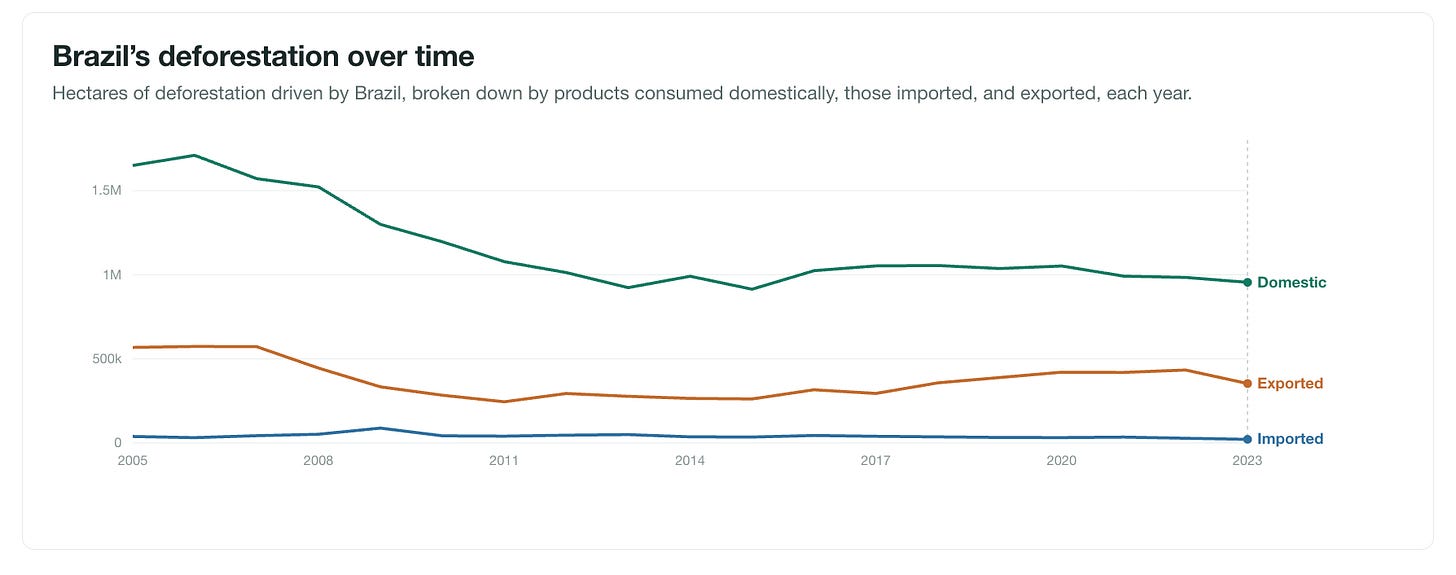
2. The domestic demand story is particularly true for beef, the largest driver of deforestation
Beef is the largest driver of deforestation globally, and Brazil has been the prime location for this forest clearing for decades. If we look at the data on where this demand is coming from, most of it is domestic.


3. Rich countries contribute substantially to deforestation through imports: mostly oilseeds, cocoa and coffee
Here’s the data for the UK. The biggest categories are now oilseeds (which is mostly soy and palm oil), cocoa and coffee. Beef imports were a large contributor in the past, but appear to have fallen quite a bit over the last few decades.

4. Countries like the UK have reduced their imported deforestation over the last few decades
The UK has very little deforestation domestically, and exports next to nothing. All of its contributions come from imported goods.
This imported deforestation, though, appears to have fallen quite a bit in recent decades. Since the early 2000s, it has dropped by roughly two-thirds.
This is true for many countries in Europe (see France and Germany as other examples), but not for the United States.
Deforestation remains a significant environmental concern in South Africa, although the country faces a somewhat different challenge compared to many tropical nations. While South Africa has relatively limited indigenous forest cover—less than 1% of the country's land area—these forests are among the most biodiverse and ecologically valuable ecosystems in the country.
In 2026, pressure on South Africa's natural forests continues to come from several sources, including agricultural expansion, informal settlement growth, fuelwood collection, illegal logging, mining activities, infrastructure development, and invasive plant species. Climate change and increasing wildfire frequency are also placing additional stress on vulnerable forest ecosystems.
The country's indigenous forests are primarily found along the eastern escarpment and coastal regions of the provinces of KwaZulu-Natal, Eastern Cape, Mpumalanga, and parts of the Western Cape. These forests play a critical role in water regulation, soil protection, biodiversity conservation, and carbon storage.
One of the biggest concerns is the ongoing clearing of natural vegetation for agricultural and residential development. As South Africa's population continues to grow, pressure on land resources increases. In some areas, forests and natural woodlands are cleared to make way for crop production, livestock grazing, housing developments, and infrastructure projects.
Illegal harvesting of indigenous trees remains a challenge in certain regions. Valuable hardwood species are sometimes targeted for timber, furniture production, and fuelwood. Rural communities facing economic hardship may also rely on wood collection for cooking and heating, particularly in areas where alternative energy sources remain expensive or inaccessible.
The impact of invasive alien plant species has become another major environmental issue. Species such as black wattle, eucalyptus, pine, and lantana can outcompete indigenous vegetation, alter water availability, increase fire risks, and reduce biodiversity. Significant resources continue to be invested in clearing invasive plants through conservation and environmental management programmes.
Wildfires have become increasingly destructive due to prolonged drought conditions, rising temperatures, and changing weather patterns. While fire is a natural part of many South African ecosystems, uncontrolled wildfires can damage forests, destroy habitats, and hinder natural regeneration processes.
Deforestation and forest degradation have broader consequences beyond the loss of trees. Forests support wildlife habitats, protect water catchments, improve air quality, prevent soil erosion, and help regulate local climate conditions. The loss of forested areas can therefore have negative impacts on agriculture, water security, biodiversity, and rural livelihoods.
Conservation efforts continue across the country through government programmes, private conservation initiatives, community forestry projects, and environmental organisations. Reforestation, habitat restoration, sustainable forestry practices, and improved land management are increasingly recognised as essential strategies for protecting South Africa's natural resources.
For farmers, the issue is particularly important because healthy forests contribute to stable water supplies, improved soil health, pollinator populations, and overall ecosystem resilience. As climate variability increases, protecting natural vegetation may become even more critical for long-term agricultural sustainability.
The challenge facing South Africa in 2026 is finding a balance between economic development, food production, housing needs, and environmental conservation. While progress has been made in protecting many indigenous forests, continued vigilance, responsible land management, and sustainable development practices will be necessary to ensure these valuable ecosystems remain available for future generations.