









-Welcome to our world- the real world of Farming and Agriculture in South Africa- Local and International news- (Farmingportal.-168,260 hits per minute)
 This AGRI NEWS RUSH - Just that one Step Ahead -Some of the news stories of this week-, SUNDAY EDITION - ALWAYS ON TIME - AGRI NEWS RUSH is now one of the most read Articles on a Sunday
AGRI NEWS RUSH - HEADLINE NEWS OF THE WEEK - www.agrinewsnet.co.za
Grain is standing ripe in the fields in the Swartland, but it has rained very little in the past two months. Farmers estimate that up to a third of the crop potential is already lost.The season started well with more than 176mm of rain in April and May, much more than the average of 66mm, so farmers planted and bought fertilizer and other inputs.
The global mango market is currently mixed, shaped by weather disruptions, smaller or delayed crops in several origins, and shifting seasonal supply windows. European markets are moving toward Mediterranean sources as Brazilian volumes rise and the Mexican season winds down.
The red meat industry is grateful that it has been given more time to comply with the new rules for exports to the United Arab Emirates, but says the real problem has still not been solved.
The number of active foot-and-mouth disease (BKS) outbreaks in South Africa declined in July 2026 for the first time since the national vaccination campaign began on 27 February. Active outbreaks fell from 2 403 on 30 June to 2 060 on 31 July. This drop was driven mainly by revised control measures rather than fewer new infections.
The Western Cape government is still awaiting a response from the national government on its request for R6.3 billion in funding to support the agricultural sector after severe flood damage this year.
Global wheat prices have risen in recent weeks.International Grains Council says prices were up 2% in August, driven by the war between Russia and Ukraine and very hot weather in the Northern Hemisphere.
Escalating mutual attacks on ports, terminals and commercial vessels by Russia and Ukraine are severely disrupting grain exports from both major Black Sea suppliers just as the new harvest begins, raising concerns that the global grain trade will struggle to absorb the impact.
Looking at just the grain price does not show the full picture. You have to see where costs are being absorbed along the chain. The silo price tells you very little about what the rest of the market can carry, because processing costs, milling margins and retail prices all move differently and do not always move together
Daar word byna weekliks gehoor van boere wat baie minder gaan plant of wat heeltemal ophou met saaiboerdery, deels gedwonge en deels uit oorlewing. Na 'n uitskiet-oesjaar waar rekords gebreek is, is baie produsente se kontantvloei steeds onder druk, en met 'n nuwe plantseisoen wat voorlê kan 'n stygende dieselprys die laaste strooi wees.
South Africa is officially projected to face a 17% water deficit by 2030, but the reality on the ground is already a crisis.The country is among the 30 driest in the world, with less than half the global average rainfall and only 8.6% becoming usable surface water. Agriculture uses 60% of what is left. At the same time, 47% of piped water never reaches a paying user, lost to leaks, theft and broken meters.
Noordwes beleef vanjaar reeds 'n erger brandseisoen as in vorige jare, en die vrees is dat die ergste nog voorlê. Daar is baie brandbare materiaal in die veld na die goeie somerreën, en met die verwagte super-El Niño wat hoë temperature kan bring, is die risiko groot. Gebrekkige hulpbronne maak voorkoming en bestryding moeiliker.
In Amerika het die Crop Tour graanmarkte wakker geskud, met mielie-opbrengste wat swakker lyk as verwag terwyl sojabone beter vertoon, en die vraag is nou of dit die begin van 'n hoër prysvlak is of of pryse weer kan terugsak.
New Zealand abolished agricultural subsidies that had taught producers to serve government rather than customers. The predicted collapse did not happen — instead, productivity and international competitiveness improved.
South Africa is closing a period of grain abundance as it heads into a challenging 2026/27 season.The Crop Estimates Committee's 7th production estimate for 2025/26 nudged the harvest up 0.02% month-on-month to 21.6 million tonnes, up 5% year-on-year and a record.
South Africa has extended the registration deadline for farms and feedlots supplying livestock for slaughter destined for red meat exports to the United Arab Emirates. Eligible facilities now have until 31 December 2026 to complete the necessary animal health and compliance requirements under the relevant veterinary notice
The disruption of grain exports in the Black Sea is worrying. We are already seeing the impact of this through rising wheat prices. In South Africa, we import about half of our annual wheat consumption, which is roughly 1.8 million tonnes.
Die daaglikse see-oppervlaktemperature oor die Suidelike Ossilasie-indeks is in die kritieke Niño 3,4-gebied en is tans 'n verstommende 2,6°C bo die 30-jaar gemiddelde. Onafhanklike weervoorspeller Johan van den Berg sê hierdie see-oppervlaktemperature is op pad om moontlik die sterkste in die aangetekende geskiedenis van El Niño te word.
New Zealand abolished agricultural subsidies that had taught producers to serve government rather than customers. The predicted collapse did not happen — instead, productivity and international competitiveness improved.
South Africa's summer crop estimate has climbed to a record 21.6 million tons in the seventh estimate by the National Crop Estimates Committee, up 0.02% from last month and 5% higher than in 2024/25. This includes maize, sunflower, soybeans, groundnuts, sorghum and dry beans.In contrast, the first estimate for winter crops points to a wheat crop of 1.762 million tons, the lowest in almost 100 years.
If you are using our content in your media coverage or on any agricultural radio programme, we would greatly appreciate it if you could credit the source. We understand how valuable and convenient this information can be—especially on a Monday morning after a weekend of NO WORK .
- Class A2/3 (super/grade A): around R66.86–R67.21/kg.
- Class B2/3: around R59.20–R60.27/kg.
- Class C2/3: around R58.40–R58.56/kg.
- Weaner calves (typically 200–250 kg): around R47.54–R49.90/kg (some provincial variation; Free State ~R47.60, higher in parts of North West/Eastern Cape).
- Class A2/3: around R106.86–R108.69/kg.
- Class B2/3: around R81.40–R85.28/kg.
- Class C2/3: around R77.80–R84.96/kg.
- Feeder/store lambs: around R56.22–R56.84/kg (some provincial variation).
- Porkers: around R30.15/kg.
- Baconers: around R29.11/kg.
- Other (e.g., sausage-related): lower, around R24/kg in some reports.
- Frozen whole bird: around R32.43/kg.
- Fresh whole bird: around R34.83/kg.
- IQF: around R28.00/kg.
Prices vary by region, class, weight, quality, and specific auction/abattoir. FMD outbreaks continued to influence red-meat markets (supply, exports, and domestic availability), while pork and poultry faced disease and import/supply dynamics. Weaner and feeder prices remained relatively resilient in places, while some super-grade carcass prices faced pressure. Retail prices (July 2026 averages) were substantially higher: beef ~R158/kg, lamb ~R187/kg, pork products ~R126/kg, chicken ~R69/kg.

- White maize: approximately R4,007/ton (up about 1.7% from the prior reference).
- Yellow maize: approximately R3,975/ton (up about 1.8%).
- Soybeans: approximately R8,620/ton (up about 0.9%).
- Sunflower seed: approximately R10,286/ton (up about 0.5%).
- Approximately R6,175/ton (down about 0.7% from the prior reference).
- SAFEX September 2026 futures last traded near R6,155, with later contracts (e.g., December) around R6,230.
Other related
- Sorghum (import parity reference, earlier data): around R4,402/ton.
- Groundnuts (Randfontein import parity): around R22,238/ton.
- Soy meal (US-derived): around R11,281/ton.

50 Key South African Headline News Stories in Agriculture, Farming & Agritech 28 August 2026
- Record summer grain and oilseed harvest of around 21.5 million tonnes provides buffer against El Niño
- Commercial maize crop forecast at largest on record, near 17.3–18 million tonnes
- Strong El Niño raises risk of hotter, drier 2026/27 summer for summer crops
- Food price inflation falls to 0.6% in July, lowest level since 2010
- Field crop margins under pressure from low commodity prices and high input costs
- BFAP Baseline 2026 outlook warns of consolidation and tighter operating environment
- Agricultural jobs hold steady at 944,000 in Q2, up 4% year-on-year
- UAE red meat export registration deadline extended to 31 December 2026
- FMD continues to reshape red meat market dynamics and prices
- Beef and lamb prices expected to remain elevated through 2027
- Pork and poultry prices supported by disease-related supply constraints
- India approves additional cold treatment options for South African citrus after decade-long talks
- South Africa remains regional grain supplier amid potential Southern African deficits
- Dam levels and soil moisture enter spring in better condition than previous drought cycles
- Winter wheat plantings fall to lowest area in nearly a century
- Conservation agriculture practices highlighted for building grain farming resilience
- Peanut butter tariff adjustment aims to level playing field for local producers
- Finance and partnerships identified as key to unlocking agribusiness export growth
- SA Young Wine Show 2026 crowns top young wines and new division leaders
- Olive oil producers compete in SA Olive Awards with international judging standards
- Soya bean yields show steady improvement but still lag global benchmarks
- Horticulture sector continues to drive export earnings despite logistics challenges
- High urea prices in Africa lag global declines, threatening fertiliser application rates
- Hemp cultivation and textile processing gain ground as industrial alternative
- AI tracking collars deployed on nearly 2,000 animals across more than 60 reserves
- Renewable energy registrations add hundreds of megawatts, including major wind projects
- Livestock producers urged to plan early for fodder and grazing under El Niño risk
- Export-led growth and infrastructure remain critical for agriculture’s path to 2050
- Animal health and biosecurity investments prioritised after FMD disruptions
- Maize and soya bean prices trade near export parity amid large supplies
- Vegetable and fruit prices show mixed movements with selective strength in onions and garlic
- White and yellow maize prices ease on ample harvest and stocks
- Groundnut prices rise while sunflower seed softens
- Sheep and beef carcass prices remain relatively firm
- Poultry frozen product prices edge higher amid supply adjustments
- Agriculture continues to outperform broader economy in recent quarters
- Trade surplus in agriculture supported by steady exports and lower imports
- Regional demand for South African maize could rise if El Niño hits neighbours harder
- Precision agriculture and technology adoption accelerate on commercial farms
- Emerging farmers expand rabbit and small-livestock projects through support programmes
- Water-efficient irrigation and climate-smart practices receive increased bank funding
- Wine and agri-tourism farms secure back-to-back experience awards
- Plant breeders’ rights progress for key fruit varieties after multi-year processes
- Dry-cow management and dairy herd health focus intensify ahead of spring
- Extensive veld management improves fertility results in sheep flocks
- Local mills explore hemp fibre to reduce reliance on imported synthetics
- Private transmission lines help unlock wind power for industrial agricultural users
- Provincial state veterinarians prioritise farm and feedlot inspections for export compliance
- Food security outlook remains stable short-term thanks to large grain stocks
- Farmers advised to monitor seasonal forecasts closely as El Niño intensifies into spring

READ MORE ( Stats) Listen to all our Daily Audiocast - It is doing very good. But also see that some news mediums like to follow us.
MORE GOOD NEWS - AUDIO AGRI NEWS NET which was selected by Million Podcasts as one of the Top 100 Agriculture Podcasts, Top 100 Farming Podcasts and Top 100 Sustainable
Agriculture Podcasts on the web. READ MORE
South Africa’s dams averaged about 96% of full supply capacity (capacity-weighted), essentially stable week-on-week and broadly in line with the same period the previous year. Total tracked capacity was around 29,320 Mm³ across more than 200 dams. Levels remained generally healthy heading into the summer rainfall season, though the Western Cape continued to lag due to its winter-rainfall pattern and a relatively dry season.
- North West: 102.6%
- Free State: 100.4%
- Gauteng: 99.7%
- Limpopo: 98.7%
- Mpumalanga: 98.5% (slight decline from 98.7% in the latest weekly update)
- Northern Cape: 88.9%
- Eastern Cape: 89.9%
- KwaZulu-Natal: 86.8%
- Western Cape: 79.9% (later reports noted a further dip to around 79.7%)
- Integrated Vaal River System (IVRS): Approximately 98.2% (stable week-on-week). This remains a strong position for Gauteng and surrounding areas, providing a buffer ahead of potential El Niño influences later in the season.
- Vaal Dam: Around 100.75–101% (eased slightly during the week of 24–28 August from ~101%).
- Sterkfontein Dam: ~98.8%.
- Grootdraai Dam: ~96.9%.
- Bloemhof Dam: ~109.8% (above full supply).
- Lesotho Highlands contributions: Mohale ~101.8%; Katse ~81.9%.
- Orange River: Gariep Dam ~99.7%; Vanderkloof Dam ~99.3% (combined system ~99.5%).
- Western Cape / Cape Town system: Provincial average ~79.7–79.9%. Cape Town Water Supply System ~76.3% (down from ~77.2%). Theewaterskloof Dam (largest in the system) ~76.7–76.8%. Some other dams (e.g., Clanwilliam) remained stronger; authorities monitored levels closely with possible earlier restrictions under discussion if declines continue into summer.
- Other notables: Pongolapoort (KZN) ~83.2%; many Mpumalanga and Limpopo dams remained near or above 100%, though with marginal declines prompting conservation reminders.
Most summer-rainfall regions held high or near-full levels after a strong wet season, with only minor seasonal declines from evaporation, releases, and demand. The Western Cape showed ongoing modest declines after its winter season. National reserves were considered adequate overall, with no widespread critical shortages reported. Officials emphasised continued water conservation, particularly in Mpumalanga and the Western Cape, and noted monitoring for possible drier conditions linked to developing El Niño risks. Data is typically released weekly by the Department of Water and Sanitation. For the precise 31 August or subsequent update, refer to the latest DWS Weekly State of Reservoirs report or provincial summaries, as levels can shift with inflows, releases, and weather.

As of mid-to-late August 2026, new detections continued in some areas while many earlier cases were resolved. In the Free State (one of the hardest-hit provinces), two new clinically confirmed cases were reported around 22 August in the Heilbron and Bloemfontein areas, bringing the provincial total to 772 confirmed cases. Of these, 577 had met requirements for quarantine lifting and 195 remained active. Cases had been confirmed in 19 Free State municipalities.
Agriculture Minister Willie Aucamp stated in mid-August that the spread was under control thanks to improved vaccine supply. Key points included:
- Approximately 13.5 million vaccine doses imported and administered nationally by around mid-August, with additional consignments (reports cited up to 10 million more expected around that period; cumulative imports referenced in the 15–17 million range earlier).
- The entire national dairy herd (about 1.385 million animals) had received at least a first dose, with second-round vaccination underway.
- Provincial progress varied; KwaZulu-Natal was approaching its 80% coverage target of an estimated 2.5 million cattle (around 1.7 million vaccinated). North West had vaccinated over 1.3 million animals (more than 80% of its target herd in some reports).
- Private-sector channels expanded, with vaccine consignments reaching private veterinarians and self-vaccination options for authorised farmers under biosecurity rules. Local production efforts and diversified imports (including from Türkiye and Argentina) supported the campaign. Target of high coverage (e.g., aiming toward 80% of the national herd) continued into late 2026.
The outbreak continued to constrain red-meat exports, disrupt supply chains, and support elevated domestic prices for beef and related proteins. Industry analyses noted lasting effects on market access and a strategic shift toward seeking FMD-free with vaccination status. Economic costs to the livestock sector have been substantial. Neighbouring countries enforced border measures to prevent spread.

- Gauteng (Johannesburg/Pretoria): Partly to mostly cloudy and mild. Highs around 22–25°C, lows near 10–13°C. Low chance of rain; pleasant conditions overall.
- Western Cape (Cape Town): Partly cloudy and cool. Highs around 16–19°C, lows near 8–12°C. Isolated showers possible early or along the coast, clearing in places; moderate winds.
- KwaZulu-Natal (Durban): Fine to partly cloudy and warmer. Highs around 25–27°C, lows near 16–18°C. Mostly dry with moderate to fresh north-easterly winds possible along the coast.
- Eastern Cape: Partly cloudy and warm in the interior; cooler and cloudier near the coast with isolated showers more likely in the south/east.
- Free State / North West / Northern Cape: Fine to partly cloudy and cool to warm. Highs typically 20–28°C (warmer in the west/north). Mostly dry.
- Mpumalanga / Limpopo: Partly cloudy and mild to warm, with possible morning fog in escarpment areas and isolated showers in the east.
Expect a mix of sunshine and cloud across much of the interior, with the best chance of rain focused on southern coastal and adjacent areas. Winds may be moderate, stronger along some coasts. UV levels will be moderate to high where skies are clearer—use sun protection. Fire danger remains a consideration in drier western/northern areas following any prior dry conditions. For precise local details, severe weather warnings, or hourly updates, consult the official SAWS website, app, or regional forecasts closer to 31 August.

DISCLAIMER
The views and opinions expressed in this program are those of the writers and do not necessarily reflect the views or positions of any entities they represent. The information contained in this website is for general information purposes only. The information is provided by CRA and while we endeavour to keep the information up to date and correct, we make no representations or warranties of any kind, express or implied, about the completeness, accuracy, reliability, suitability or availability with respect to the website or the information, products, services, or related graphics contained on the website for any purpose. Any reliance you place on such information is therefore strictly at your own risk.Just for your information. - We need to share this as this is part of Farming and Agriculture.
AGRI NEWS NET stands as South Africa’s leading source for farming and agriculture news, delivering trusted, up-to-date content 7 days a week, 365 days a year. With over 50 “good news stories you can trust,” the platform is driven by 30 years of practical farming and media experience, ensuring a deep understanding of the needs and realities of farmers and the agricultural sector. AGRI NEWS NET prides itself on being committed, independent, focused, and always on time. As part of the CRA Group, the platform leverages its extensive expertise to provide reliable, farmer-centric news. Its content is compiled using advanced AI technology, ensuring accuracy and relevance while staying connected to the broader global farming and agriculture community. For the third consecutive year, AGRI NEWS NET’s Daily Audiocast has been ranked among the top 15 agricultural podcasts on Feedspot, a testament to its quality and impact. The audiocast delivers concise, engaging updates, making it a go-to resource for farmers, industry professionals, and agriculture enthusiasts seeking timely insights. With a focus on “good news stories,” AGRI NEWS NET highlights positive developments, innovations, and successes in South African agriculture. Rooted in real-world farming knowledge and media expertise, AGRI NEWS NET bridges the gap between farmers, policymakers, and the public. Its AI-driven platform ensures comprehensive coverage, from local issues . By focusing on practical, trustworthy content, AGRI NEWS NET empowers the agricultural community to stay informed and inspired.

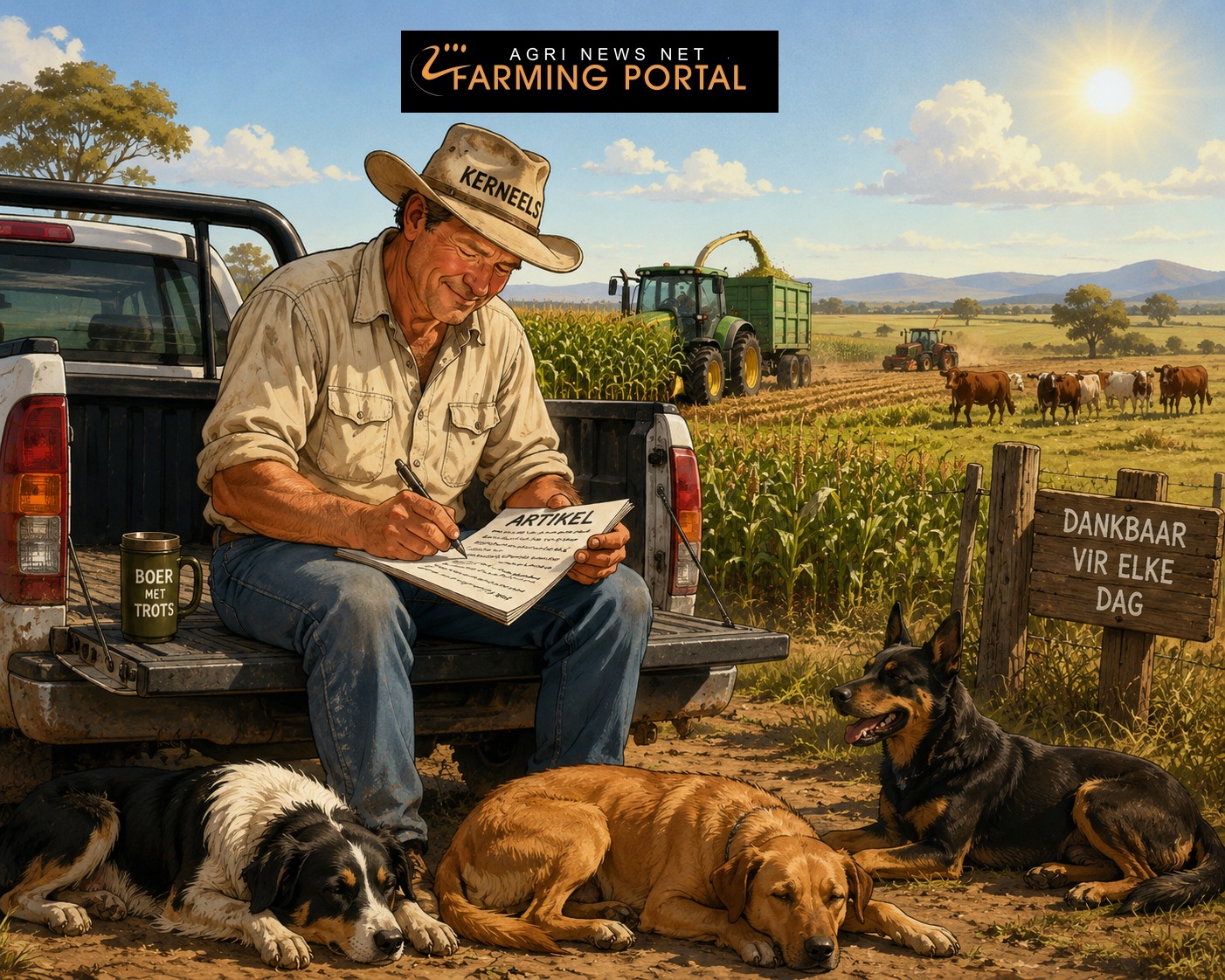
OOM KERNEELS
Van die Plaas af:
Dit was 'n baie warm week wat verby is. Ek hou van warm weer, maar as ek hoor hoe warm dit gaan word, moet ek sê ek is baie versigtig oor die somer. Die slim manne verwag baie warm, droë weer. Ek het juis 'n bietjie gaan visvang by die Vaalrivier, maar dit is nou so vuil die visse byt nie eers meer nie. Jare terug was dit die plek waar ek my kinders gereeld gaan waterski het - die rivier was skoon en niks het sleg geruik nie.
En daar wen die Springbokke die All Blacks en rugby is weer koning vanoggend. Dis groot geld wat die manne verdien en mense verwag 'n wen. Met al hierdie tegniese ontledings feite en statistieke word dit nou eintlik 'n vervelige besigheid- om nie eers te praat van die vervelige aanhoudende advertensie flitse nie. Hierdie slim manne praat vir ure oor 'n wedstryd wat iets van die verlede is- en dan word hulle hulle nog betaal daarvoor. Om nie eers te praat van die ure lange gesprekke voor die die wedstryd nie. Mense wil aksie sien- en 'n wen is wen- as jy verloor bly stil en probeer weer.
Ek sien die boere in die Wes-Kaap se oeste is baie onder druk met die min reën en dit is baie sleg vir enige boer om 'n oes te verloor of om te sien hoe 'n oes agteruitgaan. Maar oor die algemeen gaan dit dalk die voorland wees vir alles oeste met die jare wat kom.
Dit lyk of ons weer van ons vleis kan uitvoer na die Midde-Ooste, maar met die bek-en-klouseer is dit nog 'n probleem. Die manne met die witjasse hou van ons vleis.
Ek lees hoeveel mense daagliks in Suid-Afrika vermoor word - dit het net nie einde nie - die regering leef in 'n droomwêreld. Ons boere is nêrens veilig nie - hier by my is alles toegesluit en die boerboele is gereed vir aksie. Die vryheid van die plaas is ons ontneem- maar ons staan saam hier baklei ons tot die dood.
Die regering wil al hoe meer sy neus in landbou steek en wil nou ons waterook beheer. Waar hulle geld kan maak, doen hulle dit - eintlik skep hulle net werk vir hulle ondersteuners.
Groete uit die Vrystaat
Tot volgende week.
Mag julle almal ’n lekker week he ons gesels weer. OOM Kerneels.

NS -We normally do not post sponsored or external videos on our professional platforms. However, videos of this nature — which are non-marketing and informative — are not freely available YouTube channels. We will soon have our own Professional Video Channel form our own Production house.


