









 DIAAN VENTER - Hollard Insure and Farmingportal.co.za and Agri News Net - Young Agri Writers awards 2026
Preparing South African agriculture for the shocks we cannot predict
A food processor can have three suppliers and still have only one real source of supply.
On paper, the business appears diversified. In practice, the three suppliers may depend on the same irrigation scheme, import the same critical input, use the same electricity network, or move their product through the same transport corridor. If one disruption can disable all three, the number of suppliers tells us very little about how resilient the business actually is. Supply-chain research has long shown that the value of additional suppliers depends on whether disruptions are independent or capable of affecting several suppliers simultaneously (Berger et al., 2004).
That distinction matters increasingly for South African agriculture. Between 2019 and 2023, Saudi Arabia, Russia, Qatar and China together accounted for 57% of the value of South Africa's fertiliser imports (Ottermann et al., 2025). A disruption in energy markets, shipping, exchange rates or geopolitics can therefore reach a South African farm without ever occurring on that farm. The same principle applies downstream: a producer can deliver a good crop and still face losses because a port is congested, a cold chain is interrupted, an export market changes its sanitary requirements, or disease alters livestock movement and trade conditions.
Modern agriculture is therefore exposed to more than a collection of individual hazards. It operates through biological, physical, financial, regulatory and informational dependencies. Some risks can still be estimated, insured, hedged or prevented. Others interact, travel through the value chain and reveal vulnerabilities that were difficult to see beforehand.
What does the business depend on, which of those dependencies can fail together, how long can it continue without them, and what options remain when the original plan no longer works?
That question does not make forecasting obsolete. It changes the purpose of risk management: anticipate what can reasonably be anticipated, while building an organisation that can still act when reality develops differently from the forecast.
Risk has not disappeared. The system around it has changed.
Agriculture has never been a low-risk business. Farmers make decisions before knowing the weather, future prices or final yields; traders face uncertain markets; processors manage interruptions, quality problems and changing demand. What has changed is not the existence of uncertainty, but the structure through which it reaches the business.
Knight's distinction between measurable risk and uncertainty remains useful. Where probabilities are reasonably defensible, historical distributions, insurance, hedging, maintenance models and
forecasting can support good decisions (Knight, 1921). The difficulty begins when underlying relationships change, several hazards interact, or probabilities cannot be estimated with confidence.
Climate change illustrates the problem. The IPCC documents rising risks from heat, drought, flooding and compound events across Africa, while emphasising that impacts differ according to geography, infrastructure, livelihoods and adaptive capacity (IPCC, 2022a; 2022b). Historical evidence remains essential, but the past cannot always be treated as a stable distribution from which tomorrow can simply be extrapolated.
Globalisation complicates the picture without providing a simple verdict. International sourcing can transmit geopolitical, shipping and currency shocks, but trade can also diversify geographic production risk. Brenton et al. (2022) show why trade can strengthen food security under climate change, while Lim and Oh (2024) found that South Africa diversified wheat import origins after Russia's invasion of Ukraine, helping to stabilise domestic availability and regional supply. The implication is not that global or local supply chains are inherently safer. Each creates a different portfolio of dependencies.
The modern risk problem is therefore increasingly one of interdependence. Agricultural businesses sit inside networks of suppliers, infrastructure, financiers, regulators, customers and natural systems. A disturbance can originate several tiers away and arrive in a form that looks unrelated to the original event. Contemporary supply-chain research consequently treats resilience as more than recovery, incorporating preparation, adaptation and the capacity to reconfigure as circumstances change (Mamun, 2026; Zhao et al., 2024).
The decision method should match the uncertainty. Use probabilities, insurance, hedging and optimisation where probabilities are defensible. Use scenarios and stress tests where several plausible futures need to be explored. Under deep uncertainty, favour robust and adaptive strategies that remain workable across different futures. Where risks can propagate through networks, map the dependencies through which they travel (Marchau et al., 2019).
The first risk-management problem is human
Even the best risk model eventually reaches a person who has to decide what to do with it. Simon's work on bounded rationality showed that decision-makers operate with limited information, time and cognitive capacity, so they simplify complex choices rather than optimising across every possible outcome (Simon, 1955). Contemporary research still treats such simplification as central to real-world choice, while recognising that heuristics can be useful when they fit the environment (de Clippel and Rozen, 2024).
How a choice is framed also matters. Prospect theory showed that decisions are sensitive to reference points and to whether outcomes are experienced as gains or losses (Kahneman and Tversky, 1979). Consider an agribusiness paying an annual fee to preserve an undrawn emergency credit facility. Management can describe it as a cost for money that may never be used, or as the price of preserving liquidity when a disruption closes other choices. The accounting cost is identical; the decision frame is not.
Ellsberg (1961) adds another distinction: people respond differently when probabilities are known and when the probabilities themselves are ambiguous. A manager may be comfortable hedging a familiar price exposure yet far less certain about an unfamiliar trade restriction, disease pathway or geopolitical event for which past frequencies provide little guidance.
The practical implication is organisational. Risk processes should challenge assumptions, make uncomfortable information easy to escalate and allow relevant expertise to influence decisions when circumstances depart from normal operations. High-reliability research emphasises precisely this sensitivity to weak signs of failure and resistance to oversimplification (Weick et al., 1999). The cost of resilience is usually visible today, while much of its value lies in a future that may never arrive. That makes disciplined decision architecture as important as the model itself.
South Africa's risks do not arrive one at a time
South African agriculture makes the systems problem tangible. Disease, logistics, energy, climate, trade and input risks are usually classified separately, yet a disruption in one part of the system can alter the probability, cost or consequences of another.
Foot-and-mouth disease provides a clear example. By 29 May 2026, Department of Agriculture technical reporting recorded 2,162 FMD outbreaks across all nine provinces (Department of Agriculture, 2026a). The immediate hazard is biological, but its consequences move through movement controls, auctions, feedlots, dairies and abattoirs, then into processing, exports, cash flow and investment.
The response itself revealed another dependency. Vaccination is an important control instrument, yet South Africa was relying on imported vaccine supply while rebuilding domestic production capacity. In March 2026, the Department of Agriculture reported that conflict in the Middle East was disrupting the planned phasing of vaccine procurement (Department of Agriculture, 2026c). A geopolitical event outside Africa was therefore affecting the country's capacity to respond to an animal-disease emergency at home.
The cascade can be read as geopolitical disruption → vaccine procurement → vaccination capacity → disease control → livestock movement and production → processing and trade → cash flow and investment. The lesson is broader than FMD: one risk can weaken the system's ability to manage another.
Agricultural inputs provide the same logic. South Africa's fertiliser exposure links domestic crop production to global manufacturing, natural gas, shipping and the Rand. Infrastructure creates downstream transmission pathways as well. Longstanding rail and port constraints have encouraged greater reliance on road freight; that fallback preserves movement, but can add congestion, road wear, fuel costs and emissions (Department of Transport, 2025). A response that solves today's disruption can create tomorrow's dependency.
For risk management, the important distinction is between the origin of a shock and the location of its consequences. A risk can be geographically external while economically embedded in the business because the business depends on the affected resource.
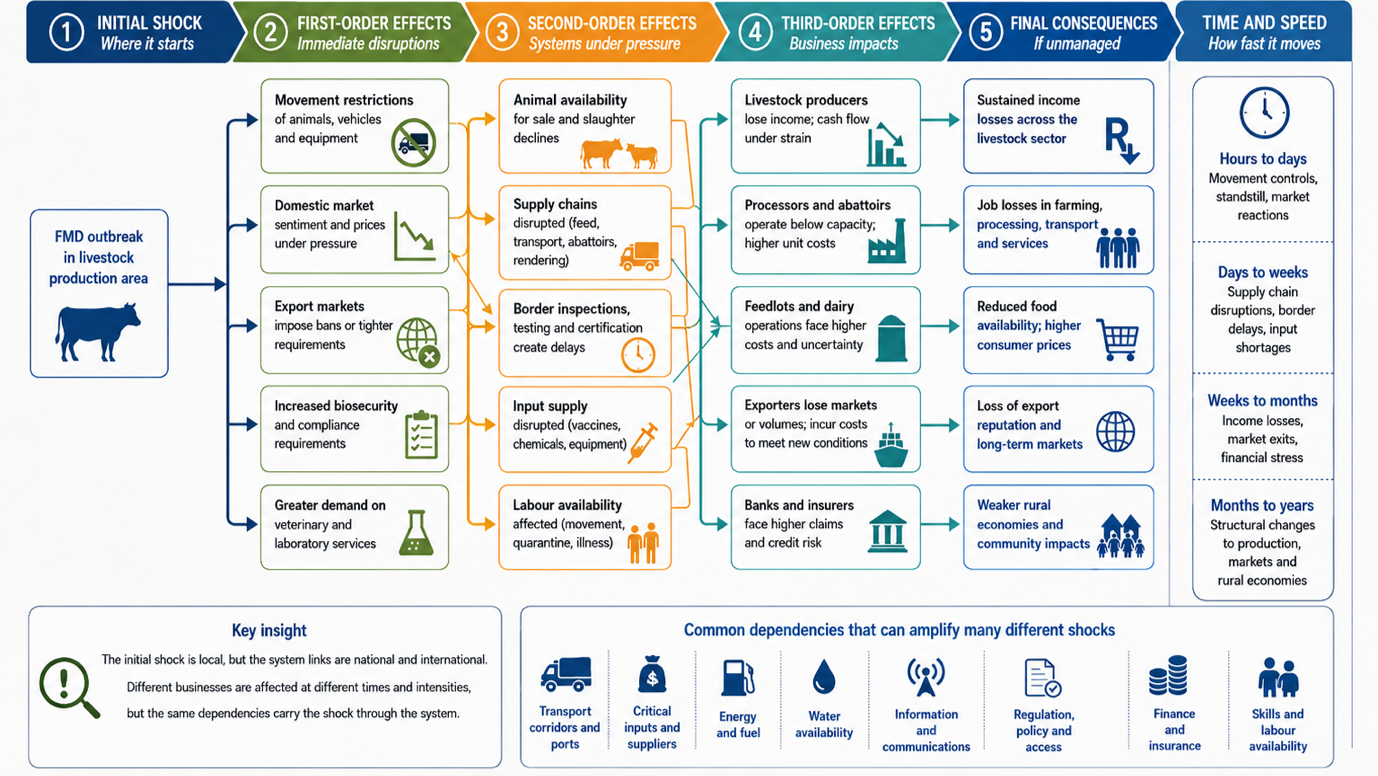
Figure 1 Illustrative cascade showing how a local FMD shock can propagate through shared agricultural dependencies.
Source: Author’s compilation based on COSO (2017), ISO (2018), Ivanov (2026a, 2026b) and Mamun (2026).
Note: This is an illustrative example. The same dependency pathways can be triggered by drought, port disruption, major input price shock, cyber incident, policy change or other hazards.
A risk register can catalogue threats. It cannot reveal the whole system.
A risk register is useful because it forces managers to name threats, compare them and allocate responsibility. ISO 31000 and COSO also go well beyond a simple heat map by linking risk management to governance, strategy, culture and performance (COSO, 2017; ISO, 2018). The problem begins when the representation is mistaken for the underlying reality.
Two risks can both appear as 'high' on a five-by-five matrix while creating very different vulnerabilities. One may be a temporary input-price increase with several substitutes. Another may be the failure of a specialised supplier with no qualified replacement for six months. Cox (2008) showed why qualitative risk matrices can compress materially different risks into the same category, depend on subjective boundaries and, under some conditions, produce misleading rankings.
A red square is not analysis.
For agriculture, dimensions such as time to impact, duration, substitutability, correlation, concentration, reversibility and financial survival time can matter as much as the likelihood-impact score. Consider a fruit exporter whose primary port becomes unavailable. The real exposure depends on whether another port can handle the commodity, whether refrigerated transport and vessel calls are available, how long the cold chain can tolerate the detour and whether the business can finance it. The risk lies in the configuration of those dependencies, not simply in the port.
Formal enterprise risk management should therefore be retained, but placed beside a map of the critical functions and dependencies that keep the business operating. If the register says the organisation is diversified while the dependency map reveals one port, one water source, one upstream manufacturer or one market-access approval on which several activities rely, the map has exposed something the list did not.
Map dependencies before ranking risks
A systems approach starts one step earlier than asking what could go wrong. It asks what must continue working for the business to function. A hazard does not determine loss on its own; consequences arise from the interaction of exposure, vulnerability, dependencies and response capacity. South African climate research illustrates this: areas facing similar climatic stress can experience different economic consequences because adaptive capacity and socioeconomic vulnerability differ (Gbetibouo et al., 2010).
Consider a feed mill. Continued production may depend on grain and protein inputs, electricity, quality testing, packaging, transport, working capital and customers able to receive product. Each dependency can then be traced further: imported additives may depend on shipping and ports; electricity on grid infrastructure or fuel for backup generation; customers on livestock production cycles and their own access to finance. The value of the map lies in showing where several paths converge.
Shared dependencies can make apparent diversification illusory. Several suppliers may buy from the same upstream manufacturer. Two transport companies may use the same corridor. Several farms may draw from one catchment. Different export markets may depend on the same sanitary status. The relevant measure is not how many alternatives exist, but how independent their failure pathways are (Berger et al., 2004).
Visibility therefore matters beyond immediate suppliers. Modern resilience research increasingly treats preparation, visibility, response, adaptation and learning as capabilities across interconnected supply systems, while emerging viability research asks whether networks can reconfigure when the original structure itself becomes unsuitable (Ivanov, 2026a; 2026b; Mamun, 2026).
A useful map also distinguishes control from exposure. A farmer cannot control the Rand, a war or a national port; an exporter cannot determine another country's trade policy. But businesses can monitor these dependencies, reduce excessive concentration where economically sensible, contract around parts of the exposure, maintain credible alternatives and decide in advance what action becomes necessary as conditions deteriorate.
Priority should reflect more than apparent probability. A dependency can deserve strategic attention because it is difficult to substitute, slow to recover, shared by many operations or essential to a function the business cannot suspend. Agriculture makes time particularly important: fruit can miss a marketing window, livestock still require feed and water when roads close, and irrigated crops cannot simply wait for infrastructure to recover.
Ask the question backwards
Conventional scenario analysis usually starts with an event and works forward: what happens if fertiliser prices rise sharply, a port closes or a major customer is lost? Reverse stress testing starts at the other end. The organisation defines an unacceptable outcome first and works backwards to identify the combination of conditions capable of producing it. The exercise does not require management to claim that a particular crisis will occur or to assign a precise probability to it. It asks where the strategy breaks, which aligns closely with robust decision-making under deep uncertainty (Lempert, 2019; Marchau et al., 2019).
Consider a dairy processor. A brief electricity interruption may be manageable. So may a delay in milk collection or a temporary refrigeration problem. If they occur together during a period of high intake, however, chilling capacity can be exceeded, product losses can rise and working capital can tighten at the same time. The importance lies in the combination, not in treating each disturbance as an independent line item. Research on agri-food systems similarly shows why compounding shocks require this wider lens (Murphy et al., 2023).
Reverse stress testing also exposes assumptions hidden in contingency plans. A plan may rely on a replacement supplier that takes months to qualify, emergency transport that has never been tested at peak season, or finance that is available only while lending covenants remain intact. A contingency is valuable only if it works under the conditions in which it will actually be needed.
Recovery time is only half the question
Every critical dependency has two clocks. Time to recover is how long the supplier, facility, corridor, utility or market takes to return or be replaced. Time to survive is how long the business can continue operating acceptably without it. Consider a seed-processing business waiting for a specialised imported spare part. A six-week replacement time is manageable if existing capacity and working capital cover eight weeks, but structurally dangerous if operations become unviable after three.
If recovery takes longer than the business can survive, the dependency is structurally dangerous.
Survival time differs across the value chain. Biological cycles, perishability and seasonal windows mean that the same duration of disruption can have very different consequences. The useful measure is therefore not recovery time in isolation, but recovery time relative to the business's operational and financial runway.
Decide what absolutely has to keep working
Resilience does not require reproducing 100% of normal operations under every conceivable disruption. A more practical objective is minimum viable function: the smallest operating configuration that keeps the organisation alive long enough to recover or adapt. A wool-processing facility, for example, might protect the minimum water, electricity, labour and critical machinery required to preserve core throughput while suspending less essential activity.
Once management knows the threshold at which continued operation becomes impossible, resilience investment becomes more disciplined. It can ask which buffer, alternative or change moves that threshold farthest away.
Resilience has a price. The question is what the option is worth.
The obvious response to vulnerability is to build a backup for everything: more stock, more suppliers, more storage, more cash, more routes. Taken far enough, that may improve continuity, but it can also make the business uncompetitive. Resilience is an economic problem as much as a risk-management problem.
Lower inventories, specialised production, consolidated suppliers and high asset utilisation can reduce costs and improve productivity. The objective is not to reverse efficiency gains simply because disruption is possible. It is to recognise where efficiency has removed an alternative whose absence could threaten the organisation. Supplier-diversification research and operational-flexibility models both show that the economically appropriate amount of redundancy depends on disruption structure, cost and switching possibilities (Berger et al., 2004; Tang and Tomlin, 2008).
The distinction between redundancy and optionality is useful. Redundancy holds additional resources that can substitute for something that fails. Optionality preserves the ability to change course after more information becomes available. Real-options logic gives that flexibility an economic language: a business can incur a smaller cost today in exchange for the right to respond differently once uncertainty resolves (Pellegrino, 2024).
Consider a potato processor. Concentrating purchases in one efficient production region may minimise normal-year cost. Maintaining qualified suppliers across climatically and logistically distinct regions will usually cost more, but it can preserve the ability to switch after a regional drought, disease event or infrastructure failure. The correct answer depends on cost, interruption severity, response speed, correlation between regions and the processor's financial capacity. It is not 'always diversify'.
If one event can disable all your backups, you have duplicated assets, not diversified risk.
The same principle applies to energy, transport and markets. An alternative has value only if it can be activated in time and under the conditions in which it is needed. Ashby's principle of requisite variety provides a deeper systems foundation: an organisation needs a sufficiently varied repertoire of responses to deal with the variety it encounters in its environment (Ashby, 1956; Schwaninger and Ott, 2024).
That repertoire will differ by actor. South African evidence from 230 firms found flexibility, agility, collaboration, visibility and adaptability across firm sizes, while larger firms relied more heavily on redundancy and diversification (Nel, 2025). There is no universally resilient configuration. The practical question is which additional option produces the greatest increase in survival and adaptability for the resources it consumes.
The second balance sheet
A business can be financially healthy and still be structurally fragile. It may have strong cash flow and manageable debt while depending on one export market, one port, one irrigation source, one specialist employee or several suppliers that ultimately converge on the same manufacturer. Conventional financial statements are not designed to reveal those dependencies.
A useful management device is therefore a second balance sheet: a resilience balance sheet. It is not an established accounting standard, but a conceptual synthesis of supply-chain resilience, real-options, dynamic-capabilities and systems research. Its purpose is to place the resources that preserve choices beside the dependencies that can remove them (Mamun, 2026; Nel, 2025; Pal et al., 2024; Tang and Tomlin, 2008).
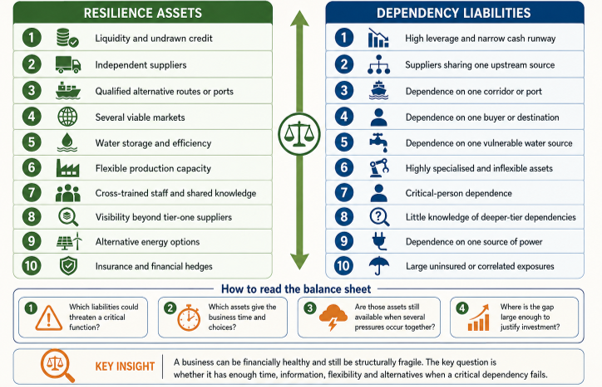
Figure 2 The resilience balance sheet, a conceptual tool for comparing assets that preserve choice with dependencies that can remove it.
Source: Author’s compilation adapted from Tang and Tomlin (2008), Teece et al. (1997), Nel (2025), Mamun (2026).
The analogy matters because resilience assets and dependency liabilities interact. Liquidity buys time; better information provides earlier warning; cross-trained people, regulatory competence and trusted relationships preserve options. Research on dynamic capabilities similarly links sensing, knowledge and reconfiguration to adaptation under changing conditions (Pal et al., 2024; Teece et al., 1997).
Dependency itself is not inherently bad. Debt can finance growth, long-term contracts can reduce costs and specialisation can improve efficiency. The problem arises when management does not know how much dependency it is carrying, what would happen if it failed, or whether the other side of the balance sheet contains enough time, information, flexibility and alternatives to absorb the loss.
A resilience asset is especially valuable when it works across several futures. Water storage can help during drought or infrastructure interruption; better supplier visibility can assist with geopolitical disruption, quality problems and regulatory compliance. These capabilities matter because they are not bespoke defences against one forecast event.
If one of our critical assumptions stopped being true tomorrow, what assets would give us time and choices, and which liabilities would take those choices away?
Sustainability changes the risk equation
Sustainability is often treated as a separate agenda from risk management. For agriculture, that separation is increasingly artificial. Environmental change alters the physical conditions of production, while governments, financiers and customers are changing the rules under which agricultural products are produced, financed and traded.
Climate is the clearest example. The IPCC identifies increasing risks to African agriculture from heat, drought, heavy rainfall, flooding and interacting climatic stresses, with impacts shaped by local vulnerability and adaptive capacity (IPCC, 2022a; 2022b). These are business risks because they affect yields, irrigation, livestock productivity, infrastructure, insurance, finance and the viability of production in particular locations.
The policy environment is changing at the same time. South Africa's Climate Change Act commenced in March 2025 (DFFE, 2025). Internationally, IFRS S1 and IFRS S2 establish disclosure standards for sustainability- and climate-related risks and opportunities, although mandatory application depends on jurisdictional adoption (IFRS Foundation, 2023a; 2023b).
For exporters, pressure can also travel upstream from foreign regulation. The EU Deforestation Regulation covers cattle, cocoa, coffee, palm oil, rubber, soya, wood and specified derived products. Under the current implementation timetable, obligations apply from 30 December 2026 for large and medium operators and from 30 June 2027 for most micro and small operators (European Commission, 2026). A South African producer may not be the EU entity legally responsible for compliance, yet a buyer's legal obligation can become a farm-level requirement through traceability, information and sourcing conditions.
This is why sustainability should not be reduced to compliance cost. Consider an irrigated vineyard evaluating water-use efficiency and on-farm storage. The investment may satisfy environmental objectives, but its resilience value comes from changing the farm's dependence on scarce water and extending the time available to respond during interruption. More efficient fertiliser use can similarly reduce exposure to imported input costs where it is agronomically appropriate (Ottermann et al., 2025).
A business can therefore have strong audits, complete disclosure and a current risk register while still depending on one port, buyer, water source, veterinary status or critical input origin. Compliance and resilience can reinforce one another, but they are not the same.
There is also a systems warning: today's resilience measure can become tomorrow's risk. Emergency groundwater extraction can protect production while worsening long-run aquifer stress; diesel generation can reduce electricity interruptions while creating fuel-price and emissions exposure. These are risk transformations, not automatic risk reductions. Management should ask what risk a response reduces, what new dependency it creates, who carries the residual risk and when that risk appears.
The distribution of risk matters as well. Insurance and hedging can transfer financial exposure without reducing the probability of the physical disruption. A powerful downstream actor can improve its own position by shifting inventory, finance or compliance burdens upstream. The evidence is not sufficient to claim that this pattern characterises South African agriculture generally, but it raises an important systems question: firm-level resilience and value-chain resilience need not be identical.
Sustainability belongs inside the resilience discussion where it changes resource dependence, market access, information or adaptive capacity. The test is not whether an initiative carries a sustainability label, but whether it improves the organisation's ability to remain viable across plausible futures without undermining the natural or economic systems on which future production depends.
From resilience to viability
Resilience is often described as the ability to 'bounce back'. The phrase is useful, but it assumes that the place we are bouncing back to still makes sense. Sometimes it does. Agriculture also faces changes for which returning to the previous state may be impossible, uneconomic or undesirable.
Robustness is the ability to keep functioning despite disturbance. Resilience adds preparation, absorption, response, recovery and increasingly adaptation (Mamun, 2026). Adaptive capacity changes practices as circumstances change; transformation becomes relevant when incremental adjustment is no longer enough. Dynamic-capabilities research has long emphasised the ability of firms to integrate and reconfigure resources as environments change (Teece et al., 1997).
The emerging supply-chain viability literature takes the progression further. Viability asks whether the system can continue fulfilling its purpose and creating value when the operating environment changes materially, even if that requires changes to technologies, products, relationships or network structure (Ivanov and Tu, 2025; Ivanov, 2026a; 2026b). This is promising frontier research rather than settled doctrine.
Consider a perennial orchard whose long-run climate and water conditions are moving outside the range on which its current cultivar and irrigation strategy were designed. Surviving one dry season is a resilience problem. If the shift persists, maintaining viability may require different cultivars, altered production intensity, new technology or eventually a different enterprise mix. Returning to the old configuration could simply recreate the old vulnerability.
The key distinction is between recovering the old system and preserving the purpose of the business. A farmer's purpose is not necessarily to grow the same crop with the same technology forever; a processor's purpose is not to preserve every existing supplier relationship; an exporter's purpose is not attachment to one destination. Once purpose is separated from the current configuration, management can ask whether the existing model still deserves protection.
Transformation itself is risky. Changing too early can destroy value just as surely as changing too late. This is why viability should be linked to scenarios, monitoring and adaptive pathways. Dynamic Adaptive Planning uses signals and trigger points to change course without fixing every future decision today (Walker et al., 2019). Real-options thinking provides similar logic for preserving flexibility while uncertainty remains unresolved.
The more demanding test is whether the business can continue creating value if some of the conditions on which its present success depends no longer hold. That goes beyond surviving the next crisis; it asks whether the organisation can recognise when recovery is appropriate and when more fundamental change has become necessary.
Build capabilities, not a catalogue of predictions
If every shock cannot be identified in advance, the practical task is to build capabilities that remain useful across different disruptions. The literature on resilience, dynamic capabilities, high-reliability organisations and decision-making under deep uncertainty supports six functions that can be brought together as a practical synthesis (Mamun, 2026; Marchau et al., 2019; Pal et al., 2024; Zhao et al., 2024):
Sense → Anticipate → Absorb → Adapt → Transform → Learn
This is not a pre-existing six-stage framework belonging to one author, and the functions should not be read as a mechanical sequence. In practice they operate simultaneously and recursively.
Sense
Sense means noticing that an important assumption is beginning to fail before the consequence reaches the business. High-reliability and dynamic-capabilities research both emphasise attention to weak signals and the ability for relevant expertise to reach decision-makers (Teece et al., 1997; Weick et al., 1999). Monitoring becomes a capability only when a small set of material indicators is connected to a trigger for action.
Anticipate
Anticipate means exploring plausible futures without pretending to know which one will occur. Robust decision-making under deep uncertainty tests how strategies perform across different futures and where they become vulnerable (Lempert, 2019; Marchau et al., 2019). The useful question is which strategy remains acceptable across several futures and when management would need to change course.
Absorb
Absorb means having enough financial, physical and organisational capacity to prevent the first impact from becoming a crisis. Liquidity, insurance, inventory, storage, backup capacity and staffing can all play this role, but the economically appropriate buffer is contingent rather than maximal (Berger et al., 2004; Tang and Tomlin, 2008). Its purpose is to preserve decision-making time.
Adapt
Adapt means being able to switch when the original plan stops working. An alternative that exists only on paper is not an adaptive capability: qualification, contracts, relationships, logistics and decision authority must exist before the disruption. Adaptive planning links monitoring to predetermined triggers for changing course (Walker et al., 2019).
Transform
Transform becomes necessary when the old configuration no longer fits the environment. It may involve changing the enterprise mix, sourcing network, technology, market orientation or location of activities. The dynamic-capabilities and emerging viability literatures support this ability to reconfigure rather than indefinitely defend an unsuitable structure (Ivanov and Tu, 2025; Teece et al., 1997).
Learn
Learn means ensuring that disruption changes future decisions. Management should identify which assumption failed, which dependency proved critical, which response created a new vulnerability and what will now change in strategy, contracts, capital allocation, training or information systems. Knowledge becomes resilient capacity when it changes action (Pal et al., 2024).
Together, these capabilities give an organisation a repertoire of responses rather than a defence against one forecast. Their mix must reflect the actor's resources, dependencies and capacity to bear risk.
Prepare for the forecast being wrong
Return to the processor with three suppliers. Its apparent diversification disappears once all three are shown to depend on the same critical infrastructure, input or production system. The weakness was never visible in the supplier count; it was in the structure connecting them.
South African agriculture will continue to face risks that can be modelled, hedged, insured or monitored. Those tools remain indispensable. But businesses also operate through systems whose interactions cannot always be reduced to reliable probabilities. Some dependencies are hidden, some shocks occur together, some responses create new risks, and sometimes the environment changes enough that restoring yesterday's business simply restores yesterday's vulnerability.
A broader risk architecture therefore asks more than what might go wrong. It identifies what must keep working, traces the dependencies behind those functions, tests where failures can combine, compares recovery time with survival time and preserves credible alternatives where their value justifies their cost. If the old configuration stops making sense, the organisation must also be capable of changing it.
The answers will differ across agriculture. A small producer cannot hold the same buffers as a large processor; fresh produce faces different time constraints from grain; banks can diversify across clients yet remain exposed to correlated systemic shocks; government and industry bodies provide infrastructure, biosecurity, information and market access that no individual firm can reproduce. There is no universally resilient agricultural business.
Resilience also has an economic cost. Spare capacity can sit idle, alternatives require qualification, liquidity has an opportunity cost and diversification can sacrifice scale economies. A robust strategy may underperform a perfectly optimised strategy when the forecast proves correct. The case for resilience is therefore not a rejection of efficiency. It is a warning against becoming so optimised for one expected future that the business has no viable move when a critical assumption fails.
Good management has always involved choosing which risks to accept and which to reduce. The additional task is to decide where the organisation cannot afford to lose its ability to choose.
South African agriculture cannot know whether its next major disruption will begin with disease, drought, infrastructure, geopolitics, regulation, finance, technology or something that currently sits outside the risk register. It can, however, understand the systems on which it depends, identify concentration, preserve financial and operational breathing room, build genuinely independent options, monitor the signals that matter and practise changing course before a crisis forces it.
Prediction still matters. The real test of the risk-management system is what happens when the prediction is wrong.
The agricultural businesses most likely to remain viable will not necessarily be those that foresaw the next crisis first. They will be those that still have enough information, capacity and credible choices to decide what to do when it arrives.
References
Ashby, W.R. (1956) An Introduction to Cybernetics. London: Chapman & Hall. Available at: https://doi.org/10.5962/bhl.title.5851.
Berger, P.D., Gerstenfeld, A. and Zeng, A.Z. (2004) ‘How many suppliers are best? A decision-analysis approach’, Omega, 32(1), pp. 9–15. Available at: https://doi.org/10.1016/j.omega.2003.09.001.
Brenton, P., Chemutai, V. and Pangestu, M. (2022) ‘Trade and food security in a climate change-impacted world’, Agricultural Economics, 53, pp. 580–591. Available at: https://doi.org/10.1111/agec.12727.
Committee of Sponsoring Organizations of the Treadway Commission (COSO) (2017) Enterprise Risk Management: Integrating with Strategy and Performance. COSO. Available at: https://www.coso.org/enterprise-risk-management (Accessed: 2 August 2026).
Cox, L.A. Jr (2008) ‘What’s wrong with risk matrices?’, Risk Analysis, 28(2), pp. 497–512. Available at: https://doi.org/10.1111/j.1539-6924.2008.01030.x.
de Clippel, G. and Rozen, K. (2024) ‘Bounded rationality in choice theory: A survey’, Journal of Economic Literature, 62(3), pp. 995–1039. Available at: https://doi.org/10.1257/jel.20231592.
Department of Agriculture, Republic of South Africa (2026a) Foot-and-Mouth Disease technical update report, 29 May 2026. Pretoria: Department of Agriculture. Available at: https://www.nda.gov.za/images/outbreaks/Foot%20and%20Mouth%20Disease%20Outbreak/Reports/2026/2026-05-29-fmd-technical-report_final.pdf (Accessed: 1 August 2026).
Department of Agriculture, Republic of South Africa (2026c) Foot-and-Mouth Disease vaccine procurement update, 23 March 2026. Pretoria: Department of Agriculture. Available at: https://www.nda.gov.za/ (Accessed: 3 August 2026).
Department of Forestry, Fisheries and the Environment (DFFE) (2025) Commencement of the Climate Change Act, 2024, 17 March 2025. Pretoria: Government of South Africa. Available at: https://www.dffe.gov.za/ (Accessed: 2 August 2026).
Department of Transport, Republic of South Africa (2025) Freight Logistics Roadmap and private-sector participation process, 23 March 2025. Pretoria: Department of Transport. Available at: https://www.transport.gov.za/ (Accessed: 4 August 2026).
Ellsberg, D. (1961) ‘Risk, ambiguity, and the Savage axioms’, The Quarterly Journal of Economics, 75(4), pp. 643–669. Available at: https://doi.org/10.2307/1884324.
European Commission (2026) Regulation on Deforestation-free Products: implementation information. Brussels: European Commission. Available at: https://environment.ec.europa.eu/topics/forests/deforestation/regulation-deforestation-free-products_en (Accessed: 2 August 2026).
Gbetibouo, G.A., Ringler, C. and Hassan, R. (2010) ‘Vulnerability of the South African farming sector to climate change and variability: An indicator approach’, Natural Resources Forum, 34, pp. 175–187. Available at: https://doi.org/10.1111/j.1477-8947.2010.01302.x.
IFRS Foundation (2023a) IFRS S1 General Requirements for Disclosure of Sustainability-related Financial Information. London: IFRS Foundation. Available at: https://www.ifrs.org/issued-standards/ifrs-sustainability-standards-navigator/ifrs-s1-general-requirements/ (Accessed: 1 August 2026).
IFRS Foundation (2023b) IFRS S2 Climate-related Disclosures. London: IFRS Foundation. Available at: https://www.ifrs.org/supporting-implementation/supporting-materials-for-ifrs-sustainability-disclosure-standards/ifrs-s2/ (Accessed: 5 August 2026).
International Organization for Standardization (ISO) (2018) ISO 31000:2018 Risk Management: Guidelines. Geneva: ISO. Available at: https://www.iso.org/standard/65694.html (Accessed: 1 August 2026).
Intergovernmental Panel on Climate Change (IPCC) (2022a) ‘Water’, in Climate Change 2022: Impacts, Adaptation and Vulnerability. Contribution of Working Group II to the Sixth Assessment Report. Cambridge: Cambridge University Press.
Intergovernmental Panel on Climate Change (IPCC) (2022b) ‘Africa’, in Climate Change 2022: Impacts, Adaptation and Vulnerability. Contribution of Working Group II to the Sixth Assessment Report. Cambridge: Cambridge University Press.
Ivanov, D. (2026a) The Viable Supply Chain: Designing for Adaptability, Purpose, and Sustained Business Value. Cham: Springer. Available at: https://doi.org/10.1007/978-3-032-21838-4.
Ivanov, D. (2026b) ‘Analytical and agent-based extensions of supply chain viability modeling in intertwined supply networks’, Annals of Operations Research, published online 14 May 2026. Available at: https://doi.org/10.1007/s10479-026-07266-y.
Ivanov, D. and Tu, Y. (2025) ‘Supply chain viability in the post-COVID era’, Omega, 137, 103359. Available at: https://doi.org/10.1016/j.omega.2025.103359.
Kahneman, D. and Tversky, A. (1979) ‘Prospect theory: An analysis of decision under risk’, Econometrica, 47(2), pp. 263–292. Available at: https://doi.org/10.2307/1914185.
Knight, F.H. (1921) Risk, Uncertainty and Profit. Boston and New York: Houghton Mifflin.
Lempert, R.J. (2019) ‘Robust Decision Making (RDM)’, in Marchau, V.A.W.J., Walker, W.E., Bloemen, P.J.T.M. and Popper, S.W. (eds.) Decision Making under Deep Uncertainty: From Theory to Practice. Cham: Springer. Available at: https://doi.org/10.1007/978-3-030-05252-2_2.
Lim, S. and Oh, S. (2024) ‘Geopolitical risks and agricultural trade diversification in Southern Africa: Port-level evidence from the Russia-Ukraine war’, Journal of the Agricultural and Applied Economics Association, 3, pp. 724–739. Available at: https://doi.org/10.1002/jaa2.141.
Mamun, M. (2026) ‘Supply chain resilience: A systematic literature review of definitions, drivers, and practices’, Transportation Research Interdisciplinary Perspectives, 38, 102055. Available at: https://doi.org/10.1016/j.trip.2026.102055.
Marchau, V.A.W.J., Walker, W.E., Bloemen, P.J.T.M. and Popper, S.W. (eds.) (2019) Decision Making under Deep Uncertainty: From Theory to Practice. Cham: Springer. Available at: https://doi.org/10.1007/978-3-030-05252-2.
Murphy, M., Carey, R. and Alexandra, L. (2023) ‘Building the resilience of agri-food systems to compounding shocks and stresses: A case study from Melbourne, Australia’, Frontiers in Sustainable Food Systems, 7, 1130978. Available at: https://doi.org/10.3389/fsufs.2023.1130978.
Nel, J.D. (2025) ‘Supply chain risk mitigation strategies for small, medium and large firms: Lessons learned during COVID-19’, Acta Commercii, 25(1), a1427. Available at: https://doi.org/10.4102/ac.v25i1.1427.
Ottermann, H.T., Truter, K.J., Haarhoff, S.J., van der Westhuizen, D., Meyer, F. and Swanepoel, P.A. (2025) ‘Trends and drivers of fertiliser consumption in the South African agricultural industry’, Agrekon, 64(2), pp. 149–166. Available at: https://doi.org/10.1080/03031853.2025.2515868.
Pal, T., Ganguly, K. and Chaudhuri, A. (2024) ‘Digitalisation in food supply chains to build resilience from disruptive events: A combined dynamic capabilities and knowledge-based view’, Supply Chain Management: An International Journal, 29(6), pp. 1042–1062. Available at: https://doi.org/10.1108/SCM-02-2024-0108.
Pellegrino, R. (2024) ‘Mitigating foreign exchange risk exposure with supply chain flexibility: A real option analysis’, Journal of Business Logistics. Available at: https://doi.org/10.1111/jbl.12338.
Schwaninger, M. and Ott, J. (2024) ‘Requisite variety revisited’, Systems Research and Behavioral Science, 41(2), pp. 235–246. Available at: https://doi.org/10.1002/sres.2964.
Simon, H.A. (1955) ‘A behavioral model of rational choice’, The Quarterly Journal of Economics, 69(1), pp. 99–118. Available at: https://doi.org/10.2307/1884852.
Tang, C. and Tomlin, B. (2008) ‘The power of flexibility for mitigating supply chain risks’, International Journal of Production Economics, 116(1), pp. 12–27. Available at: https://doi.org/10.1016/j.ijpe.2008.07.008.
Teece, D.J., Pisano, G. and Shuen, A. (1997) ‘Dynamic capabilities and strategic management’, Strategic Management Journal, 18(7), pp. 509–533. Available at: https://doi.org/10.1002/(SICI)1097-0266(199708)18:7%3C509::AID-SMJ882%3E3.0.CO;2-Z.
Walker, W.E., Marchau, V.A.W.J. and Kwakkel, J.H. (2019) ‘Dynamic Adaptive Planning (DAP)’, in Marchau, V.A.W.J., Walker, W.E., Bloemen, P.J.T.M. and Popper, S.W. (eds.) Decision Making under Deep Uncertainty: From Theory to Practice. Cham: Springer. Available at: https://doi.org/10.1007/978-3-030-05252-2_3.
Weick, K.E., Sutcliffe, K.M. and Obstfeld, D. (1999) ‘Organizing for high reliability: Processes of collective mindfulness’, Research in Organizational Behavior, 21, pp. 81–123.
Zhao, G., Vazquez-Noguerol, M., Liu, S. and Prado-Prado, J.C. (2024) ‘Agri-food supply chain resilience strategies for preparing, responding, recovering, and adapting in relation to unexpected crisis: A cross-country comparative analysis from the COVID-19 pandemic’, Journal of Business Logistics, 45, e12361. Available at: https://doi.org/10.1111/jbl.12361.
DIAAN VENTER-
I am an agricultural economist focused on understanding how natural capital, sustainability goals, infrastructure, and the economic environment shape businesses and strategic development. My expertise spans agribusiness finance, risk analysis, policy evaluation, and macroeconomic modelling, with a strong foundation in data analysis, research project management, and investment advisory.