A new study suggests that El Niño — the natural climatic chaos agent that pops up periodically and spikes global temperatures — are getting stronger because of human-caused climate change.


A new study suggests that El Niño — the natural climatic chaos agent that pops up periodically and spikes global temperatures — are getting stronger because of human-caused climate change.


One of the biggest risks facing South Africa’s economy over the next year may not come from geopolitics, higher energy prices or trade disruptions, but from the weather. Forecasts from the US Climate Prediction Center (CPC) have become increasingly confident that a strong El Niño event will develop over the southern hemisphere’s summer. How might its effects ripple through financial markets, and what could this mean for investors?
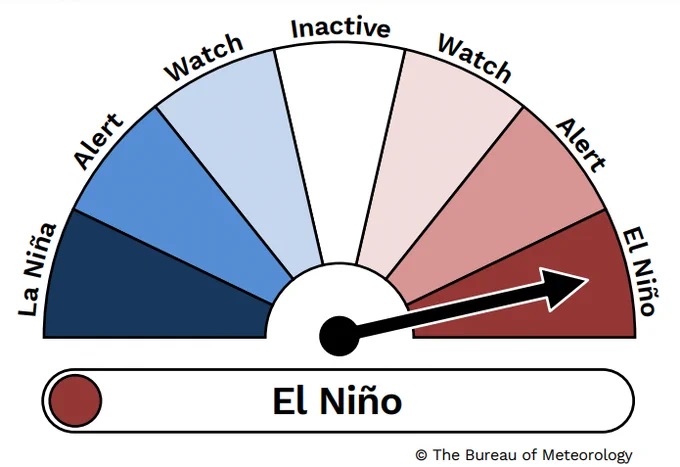
As can be seen on the chart below, current projections by the CPC assign an 81% probability of a ‘very strong’ El Niño event between October and December 2026, with the likelihood remaining above 50% through February 2027. While weather forecasts are never certain, the message is becoming increasingly clear: El Niño is highly likely. The remaining uncertainty is not whether it will occur, but how severe it will become.
Historically, El Niño has been closely associated with below-average rainfall across South Africa’s summer rainfall regions. The stronger the event, the greater the historical correlation with drought conditions, particularly across the country’s key maize-producing areas.
Other climate indicators are also providing little comfort. The Indian Ocean Dipole, another important driver of regional weather patterns, currently appears likely to reinforce the prospect of a drier-than-normal summer. While neither indicator guarantees drought, together they meaningfully increase the probability of weaker agricultural conditions.
For investors, the key question is not simply whether rainfall disappoints, but what the economic consequences are likely to be.
The obvious comparison is the 2015/16 El Niño, one of the strongest on record. That drought caused South Africa’s maize production to fall by roughly one-third compared with normal levels and pushed food inflation to around 12%. The resulting pressure on consumers, agricultural businesses and the broader economy was substantial.
There are, however, several important reasons to believe that the coming cycle is unlikely to produce a repeat of those conditions.
South Africa enters this El Niño with a number of important elements working in its favour compared with 2015.
Following abundant and unusually late rainfall, dam levels remain high, groundwater reserves are healthy and soil moisture is significantly better than it was before the previous major drought. These factors provide an important buffer for crop production, allowing farmers to better withstand a period of below-average rainfall.
The country also harvested record summer maize and soybean crops, leaving unusually large carryover grain stocks. This reduces the risk of shortages and should help smooth the impact of a smaller 2027 harvest.
As a result, while we expect maize production to decline, we believe the outcome is likely to resemble the smaller crop harvested in 2019 rather than the severe disruption experienced in 2015/16.
White maize currently trades at around R3 400 per tonne in South Africa, which is low in real terms. If prices rise to around R4 500 during mid-to-late 2027, this would represent a meaningful increase, but would still be well below the R6 000 per tonne reached during previous supply shortages.
Agriculture remains an important driver of South African inflation. Food accounts for around 18% of the consumer price basket, while maize influences prices both directly through staple foods and indirectly through livestock feed and hence meat prices. The impact is even greater for lower-income households, where food represents a much larger share of monthly expenditure.
Even so, the broader inflation picture is more balanced than it first appears. By the time higher food prices begin filtering through, the sharp increase in fuel prices experienced during April and May this year will have dropped out of the annual inflation comparison. We also expect oil prices to have moderated substantially by then, providing an offset to rising food costs.
The net result is likely to be somewhat higher inflation rather than a significant inflation shock.
The South African Reserve Bank’s inflation objective is now centred on 3%. A weaker maize harvest and firmer food inflation could therefore reduce the scope for future interest rate cuts, which had already been increased slightly in the wake of the conflict in the Middle East. Higher-for-longer interest rates would keep borrowing costs elevated and could remain a headwind for consumer-facing sectors of the economy.
While weather forecasts should always be treated with caution, several sectors appear more exposed than others:
Second-order effects are naturally less directly correlated and would only be evident from mid-2027. We view them as follows:
Although current climate forecasts point towards a strong El Niño and an elevated probability of drought across South Africa’s summer rainfall regions, the current pre-event conditions are more favourable than they were a decade ago.
For investors, the mitigating factors described above suggest that while El Niño is likely to influence inflation, interest rates and certain sectors during 2027, its overall impact on the South African economy should remain manageable rather than systemic.

User Rating: 5 / 5


The likely impact of the expected El Niño on South Africa’s agriculture and food prices in 2027 is a major point of discussion among analysts and economists in the country.
User Rating: 5 / 5


Economists are warning that a “super” El Niño weather cycle this year could cause a severe shock to global food prices lasting into 2028.
User Rating: 5 / 5


Global warming-fuelled heat and drought is already hitting yields of maize, wheat and soybeans to the tune of $20 billion a year, a study has estimated. This could rise eightfold, to more than $160 billion by 2100, unless we slash emissions.
User Rating: 5 / 5


The word is out: El Niño is here, and every adverse weather event that occurs on planet Earth for the next year is likely to be blamed on El Niño.
![]()
![]()